
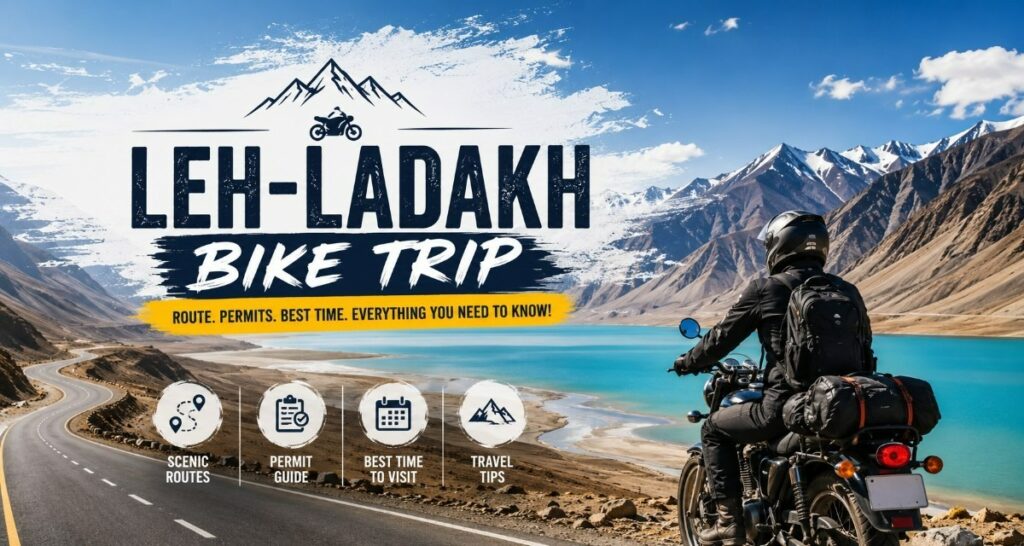
There’s a particular moment every rider talks about after a Leh-Ladakh bike trip — the first time you crest a high pass, engine straining a little in the thin air, and the whole valley opens up below you in colors that don’t look real. No filter, no photo, does it justice. That’s the moment people chase when they say they’re “doing Ladakh,” and it’s why this ride keeps showing up on every biker’s bucket list, year after year.
But here’s the thing nobody tells you upfront: a Leh-Ladakh bike trip isn’t something you wing. The altitude, the permits, the sudden weather changes, the long stretches without fuel — all of it needs planning. This guide walks you through everything, from choosing your route to what to pack, so you can spend your energy enjoying the ride instead of scrambling to figure things out at 14,000 feet.
Why Choose a Leh-Ladakh Bike Trip?
Let’s start with the obvious question — why do this on a bike instead of just flying in and hiring a cab?
The ride is the destination. Unlike most trips where the journey is just a means to get somewhere, on a Leh-Ladakh bike trip, the road itself is the experience. You’re riding through some of the highest motorable passes on the planet, watching the landscape shift from green Himalayan valleys to stark, lunar-like high-altitude desert, sometimes within the same day.
It’s a genuine test of endurance. There’s a reason riders talk about their Ladakh trip for years afterward. Long riding days, unpredictable roads, and high-altitude conditions push you in a way a regular holiday never does — and that’s exactly the appeal for a lot of people.
The landscapes are unlike anywhere else in India. Pangong Lake’s shifting blues, Nubra Valley’s sand dunes framed by snow peaks, Buddhist monasteries perched on cliff edges — a Leh-Ladakh bike trip covers more visual variety in ten days than most destinations offer in a lifetime.
It’s become far more accessible. A decade ago, this was a trip only serious adventure riders attempted. Today, with better roads, organized rental networks in Leh and Manali, and clearer permit processes, first-time riders are doing it too — as long as they prepare properly.
Best Time to Visit
Timing genuinely makes or breaks this trip. Both major routes into Ladakh are only open for a few months a year — the rest of the time, they’re buried under snow.
The riding season runs from May to September, and each stretch has its own character:
- Early season (Mid-May to June): Snow is just melting off the higher passes. Roads can be freshly cleared but rough in patches, and there’s a real chance of encountering leftover snow walls at Rohtang or Baralacha La. Fewer crowds, but pack heavier woollens.
- Peak season (July to August): Roads are in their best condition and fully open, but this overlaps with monsoon on the Manali side, which can trigger landslides around Rohtang and the lower valleys. The Srinagar-Leh route tends to be more stable during this window since Ladakh itself is a rain-shadow desert.
- Late season (September): Widely considered the sweet spot by experienced riders. Clear skies, stable roads, thinner crowds at the major viewpoints, and pleasant daytime temperatures — though nights get noticeably colder.
If this is your first Leh-Ladakh bike trip, aim for late June to mid-September. You’ll avoid the worst of the early-season snow risk and the monsoon-related landslide zones without sacrificing too much of the riding season.
Best Routes: Manali–Leh and Srinagar–Leh
There are two classic ways to ride into Ladakh, and picking between them shapes your entire trip.
Manali–Leh Highway
This is the more dramatic, more physically demanding option — roughly 490 km, usually covered over 2 riding days with an overnight stop.
- Character: Steep, rapid altitude gain. You’re thrown into high-altitude terrain almost immediately.
- Key passes: Rohtang (via tunnel or the old pass road), Baralacha La, Gata Loops, and Nakee La/Lachulung La before descending into Leh.
- Landscape: Raw, stark, almost lunar in stretches — a lot of riders say this route feels more intense and more rewarding precisely because of that.
- Best for: Riders with some prior mountain-riding experience, or those doing the classic Manali-in, Srinagar-out loop.
Srinagar–Leh Highway
Covering around 420 km, this route is gentler on your body and widely recommended for first-timers.
- Character: A gradual ascent, giving your body more time to acclimatize naturally before you hit serious altitude.
- Key passes: Zoji La, then through Drass (the second-coldest inhabited place on Earth) and Kargil.
- Landscape: Transitions beautifully — lush green meadows near Sonamarg slowly give way to the barren, rocky terrain typical of Ladakh.
- Best for: Beginners, or anyone prioritizing a smoother acclimatization curve over dramatic scenery.
Popular strategy: Many riders do a loop — entering via one route and exiting via the other — so you experience both without backtracking. Srinagar-in, Manali-out is a common combination since it front-loads the gentler acclimatization.
Permits Required
This is the part that catches the most first-timers off guard, because the rules have genuinely tightened in recent years — Inner Line Permits (ILP) are now mandatory for Indian nationals too, not just foreign tourists, for several restricted zones.
Where you need an ILP:
- Nubra Valley
- Pangong Lake (Spangmik and surrounding areas)
- Tso Moriri
- Hanle and Umling La (ILP became mandatory for these specifically since 2022 — a lot of older guides online still miss this update)
How to apply:
- Indian nationals can apply online through the official LAHDC portal (lahdclehpermit.in), which is by far the easiest route — do this before you leave rather than scrambling at the DC office in Leh
- Alternatively, permits can be arranged in person at the DC office in Leh, though this eats into your trip time
- Foreign nationals need a Protected Area Permit (PAP) in addition, and current rules require foreign travelers to move through these zones in groups of two or more
Practical tips that actually matter:
- Carry at least 5 physical photocopies of every permit. Army checkpoints along the way collect a copy each time — they don’t just glance at your original and wave you through.
- Keep digital copies on your phone as backup, but don’t rely on them exclusively — network coverage disappears completely in stretches like Hanle or the Pangong road, and you don’t want to be stuck showing a permit you can’t access.
- Always double-check the current restricted zone list before you leave — rules around specific areas near the border can shift with little warning, and the official portal is the most reliable source.
Bike Options: Own Bike vs Rental
Should you ride your own motorcycle up, or rent once you get there? Both have real trade-offs.
Riding Your Own Bike
Pros: You know the machine, its quirks, and its service history. No dependency on rental availability.
Cons: You’re adding hundreds of extra kilometers of riding just to get to your starting point (Manali or Srinagar), which means more wear, more fuel, and more fatigue before the actual Ladakh leg even begins.
Renting in Leh or Manali
This is what most riders — especially first-timers — actually do, and for good reason: renting locally is cheaper than transporting your own bike, and it avoids cross-state paperwork hassles.
Popular choices: Royal Enfield Classic 350 and Himalayan 411/450 dominate the rental market, since they’re built for exactly this kind of terrain. KTM and BMW GS options exist too, at a higher price point, for more experienced riders.
One rule trips up a lot of people: bikes rented in Manali or Srinagar can be ridden to Leh, but under current Ladakh Bike Union rules, they cannot be used for sightseeing inside the restricted inner circuits (Nubra, Pangong, Hanle). Only Leh-registered bikes, recognizable by their “LA” number plates, are permitted there. Practically, this means if you rented outside Leh, you’ll need to park that bike in Leh and rent a local one for the 3-4 days you spend exploring the interior.
What to check before renting:
- Tyre condition and tread depth — this matters more here than almost anywhere else in India
- Brakes, both front and rear, tested properly
- Full service history if the shop can show it
- Security deposit terms in writing (typically ₹5,000–₹15,000 depending on the bike)
Estimated Budget
Costs vary a lot depending on your choices, but here’s a realistic range for a self-planned Leh-Ladakh bike trip of about 9-10 days:
| Expense | Estimated Cost (per person) |
| Bike rental | ₹1,200 – ₹3,500 per day |
| Fuel | ₹6,000 – ₹12,000 total |
| Accommodation | ₹7,000 – ₹15,000 total |
| Food | ₹3,500 – ₹6,000 total |
| Permits (ILP + fees) | ₹800 – ₹2,500 |
| Miscellaneous/buffer | ₹3,000 – ₹5,000 |
| Total estimate | ₹25,000 – ₹55,000 |
A few things that genuinely move this number:
- Group size: Splitting rooms and fuel costs across a group brings the per-person cost down noticeably
- Season: June and September (shoulder months) tend to have lower accommodation rates than peak July-August
- Bike choice: A basic Royal Enfield Classic 350 versus a newer Himalayan 450 can shift your rental cost by ₹1,000+ per day
- Guided packages vs. self-planning: Packaged tours (often ₹22,000–₹45,000 all-inclusive) can actually work out similar to or cheaper than self-planning once you account for permits, backup vehicle access, and mechanic support — worth comparing both before deciding
Suggested 7-Day Itinerary
This is a compressed but realistic plan for riders short on time. If you have more days, add a rest day after Leh and one more for Pangong or Tso Moriri.
Day 1: Manali to Jispa/Sarchu Cross Rohtang and Baralacha La, gaining altitude steadily. Overnight at a camp in Jispa or Sarchu — don’t push straight to Leh on day one.
Day 2: Jispa/Sarchu to Leh Cross the remaining passes (Nakee La, Lachulung La, Tanglang La) and descend into Leh. Long riding day — start early.
Day 3: Rest and acclimatize in Leh Genuinely important, not optional. Walk around Leh market, visit Shanti Stupa, eat light, hydrate heavily, and let your body adjust to the altitude before pushing higher.
Day 4: Leh to Nubra Valley (via Khardung La) Ride over Khardung La into Nubra Valley. Explore Diskit Monastery and the sand dunes at Hunder. Overnight in Nubra.
Day 5: Nubra to Pangong Lake A stunning but long ride via Shyok Valley to Pangong. Camp by the lake at Spangmik — the changing colors at sunset and sunrise are worth the detour.
Day 6: Pangong back to Leh Return to Leh, picking up any last permits or supplies, and rest before the return journey.
Day 7: Leh back toward Manali (or fly out) Either begin the return ride or fly out of Leh if you’re short on time — Leh airport makes a one-way bike trip entirely feasible.
Accommodation Options
Ladakh’s accommodation scene has grown a lot, and there’s something for every budget:
- Hostels/homestays (₹800–1,500/night): Basic, often shared bathrooms, but a good way to meet fellow riders and get local insight
- Budget guesthouses (₹1,000–1,500/night): Simple, clean rooms, widely available in Leh and along the route
- Mid-range hotels (₹2,000–4,000/night): More comfort, private bathrooms, reliable hot water
- Camping/glamping (₹3,500–6,000/night): Common at Pangong, Nubra, and Sarchu — a memorable way to spend at least one night of the trip
- Luxury stays (₹6,000+): Available in Leh town for those wanting comfort after the harder riding days
Book Leh and Pangong stays in advance during July-August peak season — good camps and guesthouses fill up fast.
Fuel Availability
This deserves its own section because running dry in Ladakh isn’t a minor inconvenience — it can strand you for hours.
- Last major fuel points before long stretches: Tandi (on the Manali-Leh route) is the last petrol pump for a very long stretch toward Leh — top up here without fail
- Within Ladakh: Leh, Khardung La base, and Nubra have fuel stations, but pumps at Pangong, Hanle, and some interior routes are unreliable or nonexistent
- Carry a spare fuel canister for any day trip beyond Leh’s main circuit — most experienced riders treat this as non-negotiable, not optional
- Average mileage on a Royal Enfield across Ladakh’s terrain runs around 28-32 km/litre, which helps with planning how much reserve fuel you actually need
Packing Checklist
Pack smart, not heavy — space on a bike is limited, but skipping essentials causes real problems.
Riding gear:
- Full-face helmet, riding jacket, riding pants or knee guards
- Riding gloves and ankle-length riding boots
- Rain gear — mountain weather flips fast
Cold-weather layers:
- Thermals, fleece jacket, windproof outer layer
- Woollen socks, balaclava, warm gloves (temperatures at high passes can drop sharply even in “summer”)
Documents:
- Driving license, bike registration certificate (RC), insurance, PUC certificate
- Government ID and printed permit copies (at least 5)
Health and safety:
- Basic first-aid kit, personal medication
- Diamox (only after consulting a doctor) for altitude sickness
- Painkillers, antiseptic, band-aids
Practical extras:
- Power bank and charger (charging points are sparse)
- Headlamp
- Spare fuel canister for remote stretches
Safety Tips
A few habits separate a smooth Leh-Ladakh bike trip from a genuinely risky one:
- Never skip acclimatization. Spend at least one full day resting in Leh before pushing to higher passes or Pangong/Nubra. Altitude sickness is one of the most common reasons trips get cut short.
- Start riding early each day. Afternoon winds and weather instability at high altitude are real, and mornings are consistently calmer and safer.
- Avoid alcohol and smoking for at least the first few days while your body adjusts to the altitude.
- Ride within your limits on gravel and water crossings — road conditions here shift from smooth tarmac to loose gravel or slush within minutes.
- Inform someone of your daily route and expected arrival, especially on remote stretches like Hanle or Umling La where network coverage is minimal to nonexistent.
- Learn basic bike troubleshooting — a stuck clutch cable or a flat tyre at 15,000 ft is a very different problem than the same issue on a city road.
- Respect local culture and the environment — carry your trash out, and be mindful around monasteries and local communities.
Frequently Asked Questions
Is a Leh-Ladakh bike trip safe for beginners? It can be, provided you plan conservatively — the Srinagar-Leh route, a slower pace, proper acclimatization days, and possibly a guided group for your first trip all reduce the risk significantly.
Do I need an Inner Line Permit just to enter Leh city? No. The ILP is required specifically for restricted zones like Nubra, Pangong, Tso Moriri, Hanle, and Umling La — not for Leh town itself.
What’s the best month for a Leh-Ladakh bike trip? Late June through mid-September offers the best balance of open roads, manageable weather, and fewer monsoon-related landslide risks, with September often cited as the most scenic and least crowded window.
Can I rent a bike in Manali and use it inside Ladakh’s restricted areas? No. Bikes rented outside Leh can be ridden to Leh but cannot be used in the Nubra, Pangong, or Hanle circuits — you’ll need to rent a Leh-registered bike for those.
How many days should I plan for the full trip? A realistic minimum is 9-10 days including acclimatization and a couple of side trips; a compressed version can be done in 7 days, but it leaves less buffer for weather delays or altitude issues.
Is it better to book a guided package or plan everything myself? Self-planning gives you more flexibility and can be cheaper if you’re experienced, but a guided package (often ₹22,000–₹45,000 all-inclusive) removes the stress of permits, mechanic support, and backup vehicles — genuinely worth it for first-timers.
What if I get altitude sickness on the trip? Stop pushing forward immediately, rest, hydrate, and descend to a lower altitude if symptoms (headache, nausea, breathlessness) worsen. Medical posts are stationed at major points along the route for exactly this reason — use them rather than trying to push through.
Conclusion
A Leh-Ladakh bike trip rewards exactly the kind of preparation most people are tempted to skip. Get your route, permits, timing, and packing sorted, and what’s left is genuinely one of the most rewarding rides in the world — the kind that changes how you think about travel altogether.
If you’ve been sitting on this dream trip, this is your sign to actually pin down your dates. Start with your route choice, lock in your ILP application early, and give your body the acclimatization time it needs. The mountains aren’t going anywhere — but the riding season is short, so start planning now.